
Engagement

Engagement pathways

Structured ways to move from briefing to feasibility, demonstrator, assembly pathway, and scale pathway.
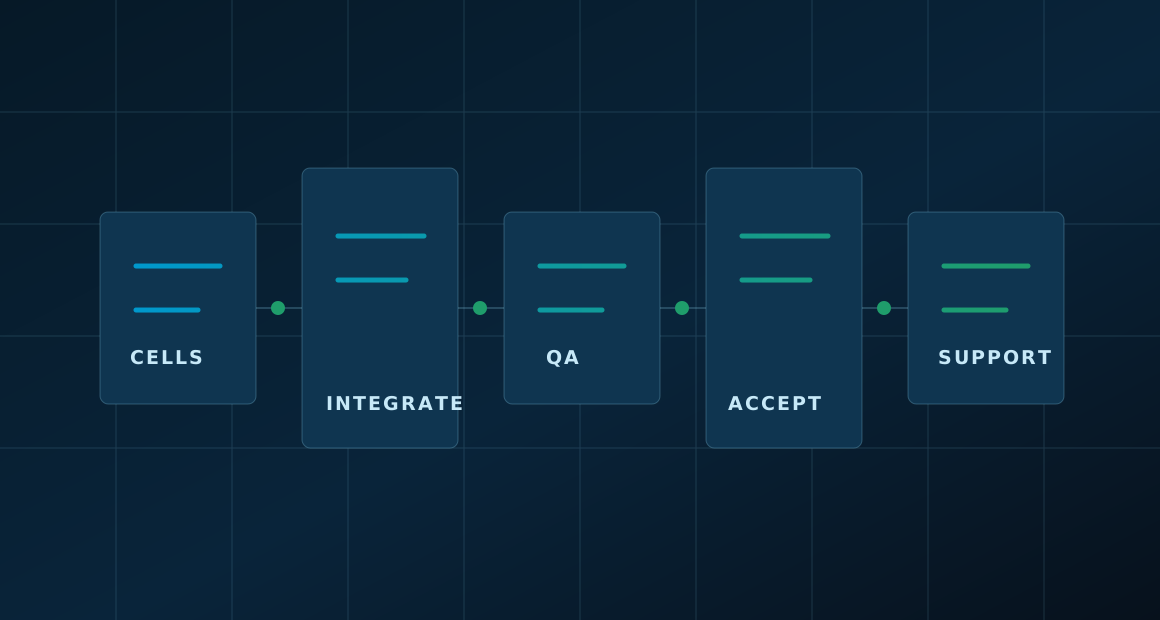
Engagement pathway workflow
Briefing, feasibility, demonstrator, assembly pathway, and scale decisions.

Route selection

Define the next useful decision

Engagement pathway workflow
Briefing, feasibility, demonstrator, assembly pathway, and scale decisions.
01

Briefing

Establish context and information access requirements.

02

Feasibility

Review operating constraints, loads, support model, and evidence gaps.

03

Demonstrator

Shape a defined-use-case pathway around acceptance criteria.

Pathways

Choose the right route before overbuilding

Technical briefing

A focused discussion for defence, infrastructure, humanitarian, investor, partner, or government audiences.

Likely output: A scoped next step: no-fit, feasibility review, demonstrator discussion, or controlled resource access.
  1. Initial enquiry
  2. Context triage
  3. Briefing agenda
  4. Next-step recommendation
Request a technical briefing

Feasibility study

A structured review of operating context, load profile, deployment constraints, acceptance needs, and supportability.

Likely output: A feasibility summary, recommended pathway, and evidence gaps for further work.
  1. Scope the use case
  2. Review constraints
  3. Identify system pathway
  4. Confirm next action
Discuss a feasibility study

Defined-use-case demonstrator

A demonstrator pathway links system architecture, acceptance criteria, documentation, and sustainment assumptions.

Likely output: A demonstrator definition with objectives, constraints, acceptance criteria, and follow-on pathway.
  1. Define context
  2. Select system pathway
  3. Set acceptance criteria
  4. Review evidence
Discuss a demonstrator

Local assembly and acceptance pathway

EDEA's pathway starts with contract manufacturing before establishing dedicated facilities where justified.

Likely output: A staged local capability pathway and acceptance model.
  1. Review national requirement
  2. Assess local assembly pathway
  3. Define acceptance pathway
  4. Plan capability transfer
Discuss local assembly pathways

National or regional scale pathway

A scale pathway considers governance, supply, acceptance, training, sustainment, and regional implementation needs.

Likely output: A high-level scale pathway with dependencies and decision points.
  1. Review validated evidence
  2. Map capability requirements
  3. Define staged expansion
  4. Confirm governance needs
Discuss a scale pathway

Assessment

What EDEA reviews

Technical briefing

Establish shared context and decide whether a deeper pathway is justified.

  • Programme context
  • Energy continuity problem
  • Candidate application
  • Information access requirements

Feasibility study

Assess whether an energy system pathway is practical for the stated use case.

  • Use case and environment
  • Energy loads
  • Deployment model
  • Training and sustainment constraints

Defined-use-case demonstrator

Shape a demonstrator around a specific operational or resilience context.

  • Target use case
  • Platform or load requirements
  • Acceptance protocol
  • Documentation and support model

Local assembly and acceptance pathway

Create a practical pathway toward in-country assembly, testing, and acceptance.

  • Assembly pathway option
  • Local capability requirements
  • QA and traceability model
  • Acceptance and training pathway

National or regional scale pathway

Assess whether a programme can move from demonstrator or feasibility into a broader resilience model.

  • Programme governance
  • Supply and assembly model
  • Training and sustainment
  • Resource access and documentation controls

Ask for the appropriate pathway

A first enquiry can be routed toward a briefing, feasibility study, demonstrator discussion, local assembly pathway, or scale conversation.